Eliezer Gonzalez
Professor Albuerme
ENGL 113000 G3
How Standard English Affects Young Dominican Immigrants
The ability to speak Standard English plays a crucial role in how young Dominican immigrants experience life in the United States. As they enter American schools, neighborhoods, and workplaces, they quickly learn that Standard English is often treated as the “proper” and most valued way of speaking. This essay explores how that expectation shapes their identities, opportunities, and sense of belonging. Drawing on sociolinguistic research by Benjamin Bailey, scholarship on standard language ideology, and the personal reflections of Dominican American author Julia Álvarez, this essay examines the complex relationship between Standard English and Dominican immigrant youth. It argues that while Standard English opens doors to academic and social mobility, it also creates pressures that can distance these young people from their cultural and linguistic roots. By analyzing both academic research and personal narratives, this essay shows that learning Standard English is not just a linguistic process—it is a negotiation of identity, culture, and self-definition.
Language plays a central role in shaping identity, belonging, and social opportunity, particularly for young immigrants seeking to adapt to a new society. For many young Dominican immigrants in the United States, learning and using Standard English becomes both an opportunity and a source of tension. On the one hand, Standard English grants access to education, employment, and mainstream social acceptance. On the other, it can distance these youth from their native Spanish and Dominican cultural practices. Scholars such as Benjamin Bailey and linguists examining standard language ideologies, alongside the personal reflections of Dominican American writer Julia Álvarez, show that young Dominican immigrants constantly negotiate between assimilation and cultural preservation. Ultimately, the impact of Standard English on these youth reveal a complex struggle between linguistic mobility and the maintenance of ethnic identity.
Benjamin Bailey’s sociolinguistic study “Language and Negotiation of Ethnic/Racial Identity among Dominican Americans” examines how Dominican youth in Rhode Island navigate contradictions between identifying as Hispanic and being racially categorized as Black in the United States. Bailey argues that Spanish language maintenance becomes a tool of resistance against U.S. racial binaries that often erase Dominican ethnicity. As he explains, “Spanish language is central to resisting such phenotype-racial categorization, which denies Dominican Americans their Hispanic ethnicity” (Bailey 197). Although young Dominicans may adopt Standard English to succeed academically or socially, they often continue using Spanish or Dominican-inflected English to assert their ethnic identity and resist being placed into oversimplified racial categories. This dynamic shows that acquiring Standard English is not merely about learning a skill; it requires negotiating one’s place within American racial and cultural systems.
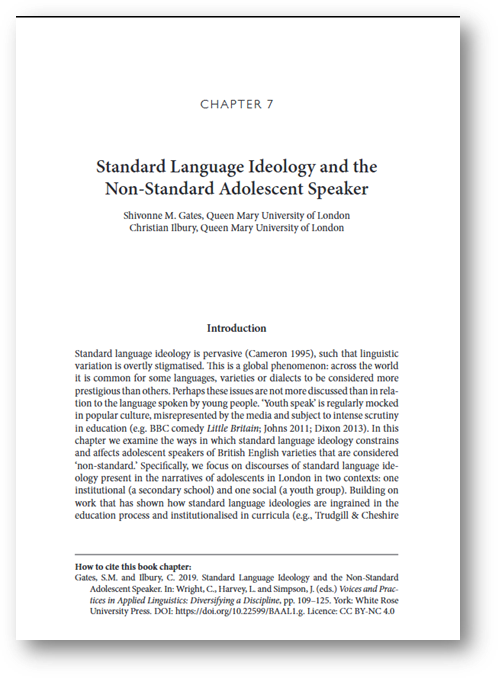
A similar tension appears in “Standard Language Ideology and the Non-Standard Adolescent Speaker,” a chapter from Voices and Practices in Applied Linguistics: Diversifying a Discipline. The authors analyze how multilingual adolescents encounter institutional pressures to conform to Standard English. They argue that standard language ideology constructs non-standard speech as inferior, particularly within multicultural urban schools. They note that “in multicultural contexts … the narrative of ‘tolerance’ and inclusion frames ethnic minorities and immigrants as other, different to the ‘norm,’ and something to be tolerated” (Voices and Practices 142). Such ideologies push young Dominican immigrants to abandon their linguistic variety to be perceived as legitimate speakers. The pressure to adopt Standard English, therefore, is not simply practical; it is ideological. It reinforces a hierarchy in which Dominican Spanish or Dominican-influenced English is stigmatized, leading youth to experience internal conflict and linguistic insecurity. This aligns with Bailey’s findings by showing that language choices intersect with questions of identity, social belonging, and institutional expectations.
Julia Álvarez’s personal reflections offer a lived experience of the linguistic transitions discussed by these scholars. In her essay “What We Believe About Identity,” Álvarez describes her family’s struggle to define themselves upon arriving in the U.S., noting that “one of the baffling things…was having to find a term for ourselves” (“What We Believe”). English became part of their new life, yet Spanish remained a cultural anchor. Her experience illustrates how learning Standard English is tied to navigating new identities—in her case, finding a place between Dominican and American cultures at a time when the term Dominican American had not yet entered common use. For young Dominican immigrants today, this process continues: Standard English may help them fit into American society, but it also forces them to reconsider what it means to remain Dominican.
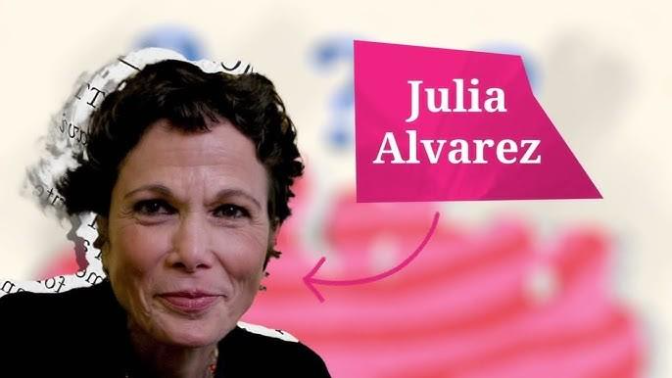
Álvarez expands on this tension in her interview for PBS’s American Masters, where she discusses how linguistic “mistakes” became part of her creative voice. She recalls, “I wrote the book in ESL and leaned into the ways those of us who speak multiple languages make ‘mistakes’ … but through these ‘errors’ we learn something new about English” (“Julia Alvarez on Language”). Rather than rejecting her bilingual voice to conform to Standard English, Álvarez embraces her hybrid linguistic identity as a strength. The National Endowment for the Humanities profile on Álvarez reinforces this idea, noting that although she writes in English, she carries “a Dominican accent” in her storytelling and cultural themes (“Julia Alvarez Wrote English Prose”). These accounts demonstrate that adopting Standard English does not necessarily erase Dominican linguistic identity; instead, some young immigrants integrate both languages, forming a hybrid voice that resists full assimilation.
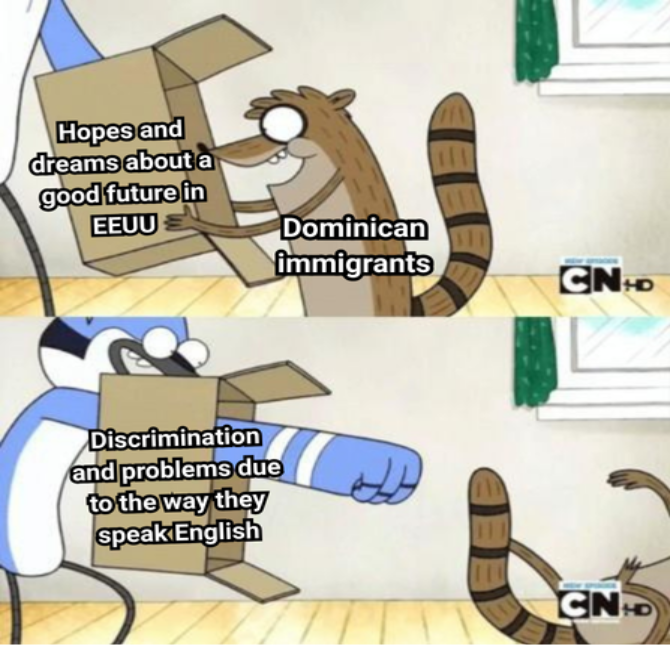
Together, these sources reveal a complex picture of how Standard English affects young Dominican immigrants. Bailey’s research highlights how language is deeply tied to ethnic and racial identity, while the applied linguistics chapter uncovers institutional ideologies that treat Standard English as the only legitimate variety. Álvarez’s personal narratives show how learning English can be both empowering and alienating, offering opportunity but prompting questions of cultural belonging. Across these perspectives, a consistent theme emerges: Standard English offers access and mobility, yet it also pressures young immigrants to downplay their heritage language practices. At the same time, many Dominican youth navigate this tension through bilingualism, code-switching, or retaining linguistic features that reflect their cultural roots.

This entry is licensed under a Creative Commons Attribution-NonCommercial-ShareAlike 4.0 International license.

